Profhilo skin rejuvenation: Too good to be True??
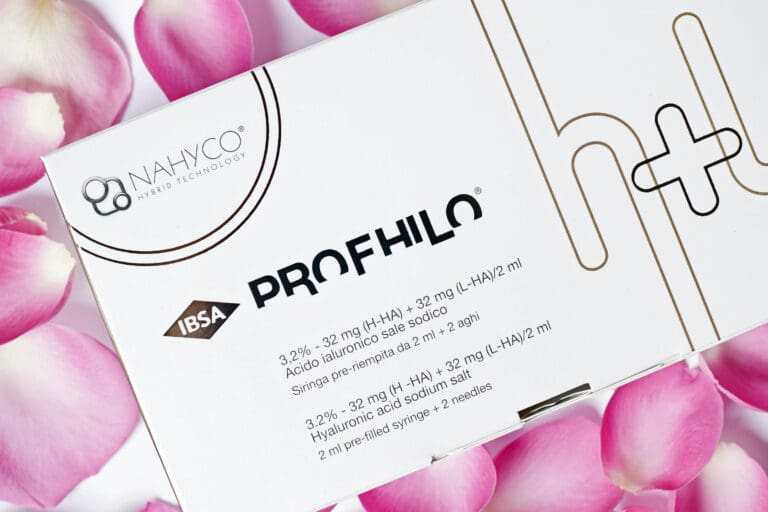
Profhilo skin booster counteracts the aging process in the dermal layers

The injectable treatment is formulated with pure hyaluronic acid (HA), which provides deep hydration and stimulates the cells within the skin to produce more collagen and elastin.
HA is always present in the skin matrix and is responsible for activating cell growth and healing. From the age of 35 onwards HA is depleted, leading to markers of skin aging such as laxity, dermal thinning, and line formation. We may reverse this by boosting HA intradermally.
This innovative treatment is leading the aesthetics industry in the new generation of skin rejuvenation. Rather than changing the facial features, it is improving skin quality, structure and radiance.
Since the benefits of Profhilo are not as immediate and dramatic as other aesthetic treatments, it is reassuring to see the evidence backing the results before investing your time and money.
Profhilo is unique in that it is manufactured with a thermal stabilization process to combine high molecular weight HA with low molecular weight HA, without introducing any other chemicals or ingredients. This combination results in two different actions, hydration and skin repair, throughout all layers of the skin. Furthermore, the two molecular weights protect each other from enzymatic degradation, prolonging the duration of effect. The formulation also has a lower viscosity than similar products, allowing it to diffuse into a more widespread area of the face.
This product development is based on a study by D’Agostino et al. (2015), which found that high molecular weight and low molecular weight HA perform better in skin wound healing than HA alone. Furthermore, Stellavato et al. (2016) found that combining these two weights of HA results in higher levels of type I and type III collagen in fibroblasts and type IV and VII collagen in keratinocytes. Similarly, elastin expression in the skin is increased when treated with the hybrid complex. Furthermore, the combination results in HA being released into the skin cells for a longer duration of time and increasing tissue remodeling.
The following four studies stand out in measuring the outcomes for a group of patients receiving the initial protocol, which is to have two treatments to the face, one month apart (a third treatment may be optimal for some people). The full benefit should be reached one month after the second treatment.
Laurino et al. (2015) assessed facial hydration and elasticity in 11 women for three months following treatment. They found a significant improvement and concluded this is ‘a good treatment option to restore vitality and turgidity of skin presenting the signs of aging’.
Beatini et al. (2016) used a micro camera to measure the skin hydration and viscoelasticity in 15 female patients. The result was a statistical increase in skin hydration after the first treatment and a statistical increase in viscoelasticity after the second treatment.
Sparavigna and Tenconi (2016) followed 64 female patients for four months using six different clinical instruments to measure skin hydration, elasticity, depth of lines, and facial volume. Significant improvements were documented four weeks after the first treatment, and maintained throughout the 16 weeks.
Goltsova and Shemonaeva (2019) utilized the global aesthetic improvement scale alongside photographic evidence, 3D microstructure capture and quantitative data on skin hydration levels and elasticity to measure the effect of Profhilo for 10 female patients with signs of aging in the lower face. Their patients were treated with Profhilo at three sessions, each one month apart. The results were analyzed one month after this course of treatment and found a statistically significant 29% improvement in skin hydration and 47.4% increase in skin elasticity. A 3D Complexion analysis highlighted a clear reduction in wrinkle depth and smoothing of skin texture.
These findings are all summarized in a systematic review conducted by Ghatge and Ghatge in 2023, which evaluated 13 studies on “The effectiveness of Injectable Hyaluronic Acid in the Improvement of the Facial Skin Quality”. This found ‘a significant improvement in facial skin quality, in terms of hydration, firmness, skin-tiring effect/fatigue, brightness, texture, radiance, and elasticity.’. Furthermore, a formulation of HA alone, as found in Profhilo, was more effective than formulations with a mix of ingredients.
If you would like to know more about how this treatment could benefit you, please contact Laura through the website or book a consultation with the “Book Online” button.
You may also contact Laura if you would like to access the full research references.